


Silk Road Nexus: Interview with Darin Brannan (Terminal Industries)
Last week I posted about Terminal Industries, while I was still working on finalizing the video. This is the full interview with Darin Brannan, CEO of Terminal Industries.
Most supply chain tech focuses on the warehouse or the customer, but one-third of the territory remains largely unmodernized: The Yard.
Darin is a serial entrepreneur and Terminal Industries is his fifth startup. Learning and understanding the value chain before investing are his key traits that I believe has led to a great value proposition for Terminal which is ready to disrupt the traditional and legacy platforms that manage the yard.
Full interview here.
Nikhil Varshney: Hello and welcome to Silk Road Nexus Conversations. I am at Manifest 2026 in Vegas over here and I’m privileged to have Darin with me who is the CEO and co-founder of Terminal Industries based out of Austin. Usually when we talk about supply chain, we talk about a lot of tech that goes into warehouses, that goes into making sure customers are buying the right products, but there is a hidden aspect of supply chain which is very crucial and it’s the yard.
Nikhil Varshney: Yard is a place where all the freight come in, they stop, they unload, and they finally leave. But that portion of managing that yard is a very big pain point and a problem in the supply chain that leads to lot of disruptions, that lead to lot of delays, and a lot of wrong shipments as well. Terminal has been founded to kind of solve that particular problem. But before I jump into that, Darin, why don’t you quickly introduce yourself.
Darin Brannan: So first off, I’m delighted to be here. Thank you for having us on this podcast. My background is I’m a transplant. I live in Austin, Texas, but I’ve been transplanted from the Bay Area where I spent a third of my career as a VC and then lept across the table to try my hand at entrepreneurship. So I became a tech entrepreneur and now I guess a tech business builder and a terminal is my fifth startup slash business to build. Staggering.
Nikhil Varshney: Yes, so I love the business of starting businesses that lead to market leadership that drives real outcomes for customers. Awesome. And like fifth one, what happened to the previous four? How are they doing?
Darin Brannan: Yeah, so the prior four, three of the four had really nice unicorn IPOs. OK, so fantastic returns for all employees and investors. And the last one, we were close to that trajectory, but COVID was not our friend and hurt some of our growth, but the company is still doing well and maintained a market leadership in its category. And then finally, terminal.
Nikhil Varshney: So I’m assuming when you’re talking about yard, you probably have spent some time studying what the real problems were in yard. And I know I’ve worked in supply chain for last 10 years. I’ve worked with Wayfair and we have a big problem with yard management as well. But at the end of the day, I want to hear from you. What have you seen are the biggest problem in yardage?
Darin Brannan: Yeah, one of the reasons I was attracted to build another business with some of the brightest investors and strategic investors here is one, they did fantastic due diligence, competitive analysis and landscape on the market. Then I did my own prior VC and entrepreneur landscaping and market analysis. And it confirmed that the yard is one of the last and it’s large. It’s one third of the supply chain territory is one of the most unmodernized nodes in all of supply chain.
And there’s reasons for that. It’s unstructured. It’s highly variable. SAS tech has been hard to ROI in that category relative to the warehouse and TMS space. And so it’s been largely overlooked as a node of high, can just almost congestion in a sense that it’s just a cost of doing business. They’ve just dealt with it with processes and a patchwork of, of technology. And it’s now finally reached the point where you have adoption of WMS and TMS in the 70 to 80 % of tech that ROIs and only 25 % of the art. And it’s now causing, the investments in TMS and WMS to be bit diluted because it’s chipping away at the efficiency and throughput when you have congestion in an unmodernized environment.
Total TAM and Available Value - Outside of Interview (Added by SRN)
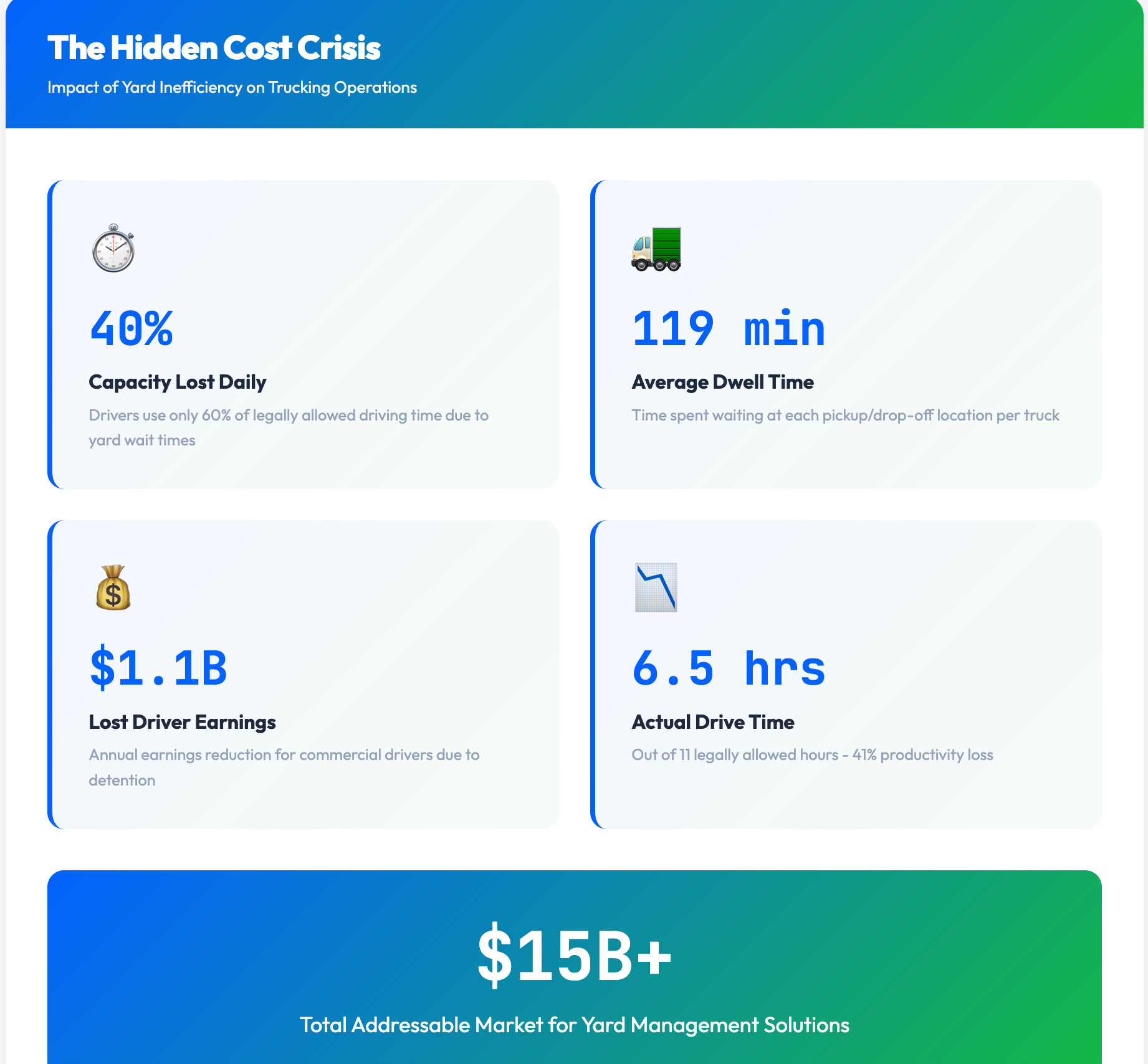
And so to me, that was a large growing and underserved market that had a patchwork of tech companies that were sort of 1.0, 2.0 tech that outpriced themselves. There’s a number of reasons why there wasn’t adoption. And then when I teamed up with ABC and their strategic investors, Rider, NFI, Lineage, some of the biggest players in the industry, they all affirmed that this is a cluster of pain points that they’d love to have a single full stack modern AI agentic computer vision, if possible, build that company so that they have a really sustainable platform that’s modular and configurable for the art that works. And that’s a long answer to you.
Nikhil Varshney: I mean, it’s fantastic because I mean, what it leads to is like, if you can help us understand the size of the problem, because I mean, when we look at logistics, it’s a very big industry and it has a lot of touch points. And the value chain of logistics include yard in it because at the end of the day, trucks have to come, trucks have to go. So there is a value chain associated with it. But what is the size of the problem if we were to kind of like ballpark it in certain figures?
Darin Brannan: Yeah. And so I’ll bring it down to the street and then I’ll bubble it up to the macro view. But the thing that struck me is the biggest problem in the industry relative to the yard is that because it’s under modernized, the tech doesn’t work there the way it should in terms of real orchestration, real movement, real efficiency, real velocity, visibility. It’s created nearly a 30 to 40 % under utilization of truck time. Normally you have 11 hours of truck time. It only gets on average six hours. So 40 % and the majority of that is buffered in the art because the scheduling, the... The stage is the minute you’re off schedule by a few minutes, it just creates congestion because everything’s manual written. So that’s the main problem. And then that in terms of the market spend, it’s in a four billion range is the market size for the problem. Yeah, that’s the problem. And then we add, we’re adding security fraud because we have cameras there that can detect all sorts of things. And then we do damage detection. And now you’ve just quadrupled that time.
Nikhil Varshney: Wow. So basically we are looking at 12 to 15 billion dollar of a market, which is underserved at this point in time and is a very crucial aspect of the entire supply chain.
Darin Brannan: Right. Within just the art notes, just the art. And that’s inland. And then we have opportunities else international and for tomorrow. Obviously.
Nikhil Varshney: But just kind of double clicking on that one number that you mentioned that the truck utilization is 11 hours and that kind of gets cut down by 40 to 35 percent. What does that 11 hour mean? Like, is it the drivable duration of a truck. And then basically we are only driving it for six hours. So we are losing four to five hours of drive time of the truck.
Darin Brannan: Just because it’s in the yard. that manifests in trucks waiting outside of the gates for four or five hours, three hours, waiting inside the gate, waiting to be slotted. And that’s just the way the business has been done for decades. And again, because there’s fewer people in the yard, So the warehouse may have 20, 50, 80 people, more structured workflows data. That was easier for tech companies to essentially attack that industry. But the strong ROI case, same for over the road. But the yard, highly unstructured. So many different moving assets, moving actors, so many different movements that traditional software was hard to build with kind of clumsy IoT devices, RFID, GPS, when you add it all up, it just becomes a cost prohibitive tech stack that’s 100, 150,000 a year. And that doesn’t work for that node. So they’ve just left it as largely, 80 % of it is not digitized, it’s not optimized, it’s certainly not automated. And that’s our business is to come in and modernize it with those three things in mind with our tech stack.
Nikhil Varshney: Makes sense. And then, when we look at the problematic part, is it also the paperwork that happens in the yard? Is that a problematic part or are you saying that would be outside of the scope of like what yard management actually includes?
Darin Brannan: So our platform, again, we’re out to, we’re a very mission driven company. Our mission is to make goods flow better, faster, cheaper, cleaner by modernizing the yard, first digitizing it, which was that paper element. Then that allows us to optimize the yard. optimize the gate, yard and dock, and then that leads to the autonomous yard of the future. And we’re doing that with the only agentic AI platform in the industry in the world today, combined with best in class computer vision that we’ve built that has the highest detection, highest accuracy rates.
So when you combine those two, and you’re able to get the full benefits, almost irrefutable benefits of AI and agentic, which is one third, one half the price. 10 times the capability, one third the deployment time, three times the ease of use. That’s a game changer. That model, if it’s deterministic, will work in the yard to help reduce the paper flow. And at the gate, that’s where we see the biggest problems. You have manual check-in with paper, and we can eliminate that within two seconds. We capture all the ID information, pull it up on their web app, and it just confirms it. Or it can be a fully autonomous gate.
And so now you have there was anywhere we were finding anywhere from 20 to 40 % accuracy issues at the gate that they just funged through the art. That’s just how they did things. Like it created chaos and then they’d go try and solve for the chaos. Now we bring that accuracy rate to nearly 100%. So that’s one main efficiency and velocity. And the other is just the throughput. We, on average, when you set up our cameras, if it’s hybrid, we’ll do a check in in 34 seconds versus. two, five, we didn’t see 15 to 20 million check-ins.
Nikhil Varshney: Got it. And then just to double click on that number where you say that there is a gap in efficiency at the check-in itself, like 20 to 30%. What is the inefficiency over here? Is it the gatekeeper is not able to identify the trucks properly? It’s taking a lot of time or the inaccuracies are in the form of wrong data?
Darin Brannan: It’s so it’s it’s it’s both. It depends on the type of yard and the type of clients they have in that yard or the manufacturer. But oftentimes the universal workflows where it’s not well digitized and sometimes there’s a little bit of digitization there, but it’s just a record keeping digital record keeping. It’s not doing the door. The database correlation lookups and confirmation that that data is right, that this is the right truck with the right load. at the right time going to the right spot in the yard.
typically happens, most of that happens at the gate where captioning information, running intelligence on it, and then reaffirming that the accuracy is complete and that the asset can now be tracked with additional cameras in the yard for full live real-time visibility of that asset. So no longer are they running around with papers are stickies trying to figure out, especially in moderate to sophisticated yards. And there’s a lot of paper, have yard checkers that are constantly tracking what’s been moved where that’s no longer needed with our sort of simple deploy easy to run tech that was the most advanced.
Nikhil Varshney: How do you see the adoption going for yard management today? Like our company is open to that. it like? still a back burner issue and people are not talking about it. What’s the market?
Darin Brannan: It’s an excellent, it’s an excellent question. That is the question I always ask before I get started in building the business is why, why now and why us? And if I don’t have positive affirmation of a short checklist on each of those, the timing could be off. And my view is the success of startups or business building is one third market timing. especially when you’re selling into mid to enterprise. So that’s a backdrop.
What I found here when I joined up with this, the investors and strategic investors is, A, we had the signals from the strategic investors, the riders, et cetera, that their view was, post-COVID, we’ve made our investments in WMS and we’ve cycled through the things that don’t work and work and now we’re feeling comfortable with that. We’d love to revisit the yard. And we’ve heard there’s new smart yard tech and they did that over three or four years ago, but the tech just wasn’t scalable or effective. So they felt like that got burnt.
OK. So AI is now a catalyst for them to revisit to see if there’s new tech vendors and sure enough, terminals, the dominant space is. So I’d say, sorry, I just want to finish that thread. Cause this gets to your point is I’d say a couple of years ago, maybe six, six to 10 % of the market was in market looking for yard tech. OK. My sense, and having done this multiple times, it’s somewhere in the 20 to 50 % or 60%. It’s a big range. But it’s quadrupled in terms of people in discovery to look at smart yard tech. Because they don’t want it to be, a patchwork of point solutions that’s bringing down their investments here, and then congestion, accuracy, all those things, efficiency, velocity. They know with the right data and the right tech, they can optimize that part of the node.
Nikhil Varshney: Got it. who is the customer in yard management? Because yard management could have third party carriers, would have their own fleet carriers. And then there obviously is the company that owns the yard. So who is the customer and where the tech goes at you? So if you can just break it down at multiple customer points and then explain like how the technology is working across different players.
Darin Brannan: Great question. So we break up our target market customer into two segments, three PLs, mid and large and shippers. Mid, large and large mean small, mid, large enterprise and mid market. So those are two massive segments. The shippers and three PLs. And on the three PL side, it’s a partnership where they’re looking to provide as much value in their tech and service stack. And they already You know, have a WMS or a TMS investment or a couple of vendors selected. And the YMS has been again less than 25 % adoption. It’s been a real challenge for them. So they’re also looking for new solutions.
And so we partner up with them. That’s the rider. That’s NFI to help them down select and standardize on one platform that they can that they know will bring 20 to 30 % efficiency, 20 to 30 % throughput when fully deployed. Those are meaningful numbers that drop to the their bottom line when they sell for that. And it makes their customers more loyal and sticky. If they have that full stack pulled together with YARF, and again, only 20 % of the market has it, and even half of those are dissatisfied. And then it helps them get new business as well. So when they’re in an RFP, we’ve been brought in by 3PLs to RFPs, it helps complete the story. we have the full stack digitization, including the yard with the most modeling yard tech stack, which is where a lot of that congestion and pain can happen today.
So that’s 3PL. Then shippers, for them, it’s all about getting their right product to the consumer at the right time and us helping them thrive by getting that faster, cheaper, cleaner by solving that yard four hour buffer that they have. And you could even look at the real estate in their environments is the ability to reduce them. Because you no longer need staging if we’re bringing the truck. If there’s a tight synchronization between the driver, even if there’s delays, usually that’s where the cognitive load falls apart. When you have delay upon the delay, then they’re stacking up.
With our system, it determines delays even two days in advance where there’s going to be condensed share. And so it’ll do the right slotting and optimization for the right deck. Doc, it’ll notify the unload load and then a fast pass for the truck driver on the way out. 10 second checkout, 30 second check in, 10 second checkout, full synchronization. That’s profound for shippers if done right.
Nikhil Varshney: But one of the problems that I see, and I just pick up on your last point over here, is that the quick check ins and quick check outs happening within seconds. But the bigger problem that I see in the yard is that there is no space in the yard. So even if you can do a quick check-in, the technology is not solving for that real issue, which is there is no space. I can’t park another truck in the yard. So is that going to still be a drawback in terms of adoption or the gains from the technology? Or do you see from your optimization software that the two can be combined together, where now you have an optimal slot creation? where you know that the truck would come in at 10 AM and there is one slot waiting for that truck, versus the truck came in and there are no slots.
Darin Brannan: Yes. So, you know, it’s case dependent, but overall we see, again, deployed properly where we configure workflows for that yard. And again, agentic is different than SAS. So you’re building ontologies around recalls. I don’t want to geek out too hard on this, but actors, assets, moves, and dynamic training. And so an actor could be the gate guard, the yard checker, the dispatcher. There’s things they do and things that happen to them and there’s movements with them.
So we create workflows, all their workflows plus all their potential attributes and we do that for assets as well. That’s trailer, chassis, et cetera. And same for dispatcher. And so what that allows for the on the ground movement is we can make sure that the scheduling happens, driver experience scheduling happens properly before they arrive. Then when they arrive, can simply, again, the velocity of the gate check in through a web app on their phone, it’ll notify them. just in this conversation will say, who are you? You can literally say I’m Chuck, which company? Rider, okay, we’ve correlated. Take a picture of your e-ball or your license. And it then says, doc four was your doc, but it’s now congested. We’ve slogged you here and we notified the pickup. Stay in your unit.
Yeah, and they’re prepared for you because they knew exactly when you were arriving and then exactly what slot and and so we unload load immediately and they’re out. That’ll reduce the that’ll optimize the archimedes to where, you our view is if done well, you’ll need very little staging. They are right because you’re you’re you’re just fully optimizing the warehouse. up the dynamic at the point. It’s it’s auto dynamic. It does auto decision making. That’s that’s the. That’s a promise of AI and agentic is once you’ve built that and it’s learned quickly, it is you’re leaning, you’re leaning towards the autonomous yard of the future kind of lights out of the future because of autonomous decision making and the way we set it up.
There’s a lot of AI that doesn’t work in enterprise. So we’ve built it from the ground up to be deterministic, which is a lot different than probabilistic product. So many weird things that can happen. Terministic is within our rules. And it ensures that that happens.
Nikhil Varshney: And then these rules, how scalable are these rules? Because every yard is different. Every company has a different structure. So when you go from, if you’re building deterministic rules, then you are kind of saying, I will have 100 kinds of different rules based on the infrastructure requirements. is that a kind of a...
Darin Brannan: That gets into a little bit of our secret sauce, but I’ll give you a hint on it. You start to build a library of these rules. And even though every yard is different and there’s different carrier shippers, cetera, you can more that leads to the instead of months of pilots and POCs, it leads to days of setup with value. You’ve got a robust library of assets, actors, dynamic moves and optimizations. that’all for it.
And that’s why it’s our belief that SAS, traditional SAS, has had a really tough, like there’s been a massive adoption problem of tech in the yard. It’s because they end up with config tables upon config tables and then brittle API stacks and you need event-based integration. it’s an entirely kind of revolutionary platform. And we’re now in a state where it’s proven out and we’re forward.
Nikhil Varshney: So when you say that you have a library that’s basically a set set of structures that probably are unchanging across multiple dynamics reusable, reusable. And then you have definitely tentacles coming out for different industries in different segments that you can now on top of that library build, which kind of reduces your deployment.
Darin Brannan: Yes. And, and, and by the way, that, that is rocket science. This is not easy to build. You build, it all together. You need AI, agentic engineers. There’s a lot of, of a heavy lift to get in here. Yeah. On the AI computer vision alone, that, takes PhDs, machine learning data scientists. to make the computer vision, which is the sort of powered by elements. That’s the most effective cost efficient way to extract the data and then track the data and then use that data and enrich the data in that deterministic model. And so we feel like we have five or six moats with that because of how hard it’s been, but we’re now set up, I think in the most sustainable tech platform the world has ever seen. Like I can’t see another transformative tech beyond this state. For anything, if you can reach an agentic AI platform state, I just don’t know what would be next beyond that.
Nikhil Varshney: True, that’s true. Because it’s autonomous, it just creates autonomous decision making, which is the ultimate goal. One thing that I want to double click on and learn more about is this computer vision. Can you help me understand what problems did you see that required the computer vision solution? And how is that working? I know we talked a little bit about check-ins, check-outs, slotting, which is optimization, but how does computer vision fit into it? Like, what is it doing?
Darin Brannan: Yeah. So the industry had kind of waves 1.0 OCR computer vision several years ago. And that claimed to do some really interesting work, but it wasn’t going to replace these GPS and RFID trackers. And so it didn’t get much traction. And the advent of real AI combined with that is a game changer. You go beyond OCR, where you’re tracking container IDs, you’re solving for occlusions, which is inclement weather, it’s covered over IDs. Like you can solve for those through AI extrapolation and annotation. it just leveled up the possibility of computer vision.
And the reason why that is becoming a pretty exciting wave for the supply chain is because they’re kind of reaching a point of, I’d say, a cluster of pain points around GPS RFID. that’s part of how the yard breaks is if they don’t scan that right, if it doesn’t have the right RFID. And then pretty soon you’ve got tags everywhere. And you’re just involved like three more manual workflows associated with that versus a camera properly. And again, lighting position, inclement weather, annotation.
There’s just a lot of complexity to build multiple model pipelines to then be able to instantaneously convert that data into meaningful insights and tracking. And so within typically less than two seconds, we’ve scanned the type of power unit. trailer chassis ran all the IDs done some database correlation seamlessly integrated with TMS WMS. We have a really good sense of who this is, what they have, where they should go, how quickly we can turn this around.
And we’ve taken just to give you a sense of that. We’ve taken environment that had GPS RFID and we’ve done pilots on this where they had five to 15 minute check-ins that then created an hour 47 minute line on three days in particular. And we were able to get that from gate to dock to unload in eight minutes through our full system. That’s 34 second check in two seconds to capture information. The guard, they kept the gate guard and they can process the correlation, make sure it’s all extra accurate. And then it slots in at the right place and notifies the right people and manages all that carrier appointment scheduling.
Nikhil Varshney: Makes sense. And now I think this is a good segue for me to kind of talk a little bit about the results, right? I mean, we talked about the problem, the size of the problem that we are looking at dollar terms, was like close to 12 to 15 billion dollars. And you’re saying 40 % of the time is unutilized for the trucks. When you have worked with these customers, how much value have they regained from that? And where has been the biggest value capture? And what has been a surprise value capture for you that you realize, oh, we didn’t think that this particular process would result in such high value capture.
Value Capture chart - Outside of Interview (Added by SRN)
Darin Brannan: Excellent question. I’ve been selling enterprise platforms for nearly my whole career and one of the key tenants to any strategy of selling a platform in that industry is tech is great. Even agentic AI, boy, that’s great to check that box so you have sustainable. But really all that they care about is cost benefit. And that cost benefit is where are the ROIs and how quickly can you prove those and are they real?
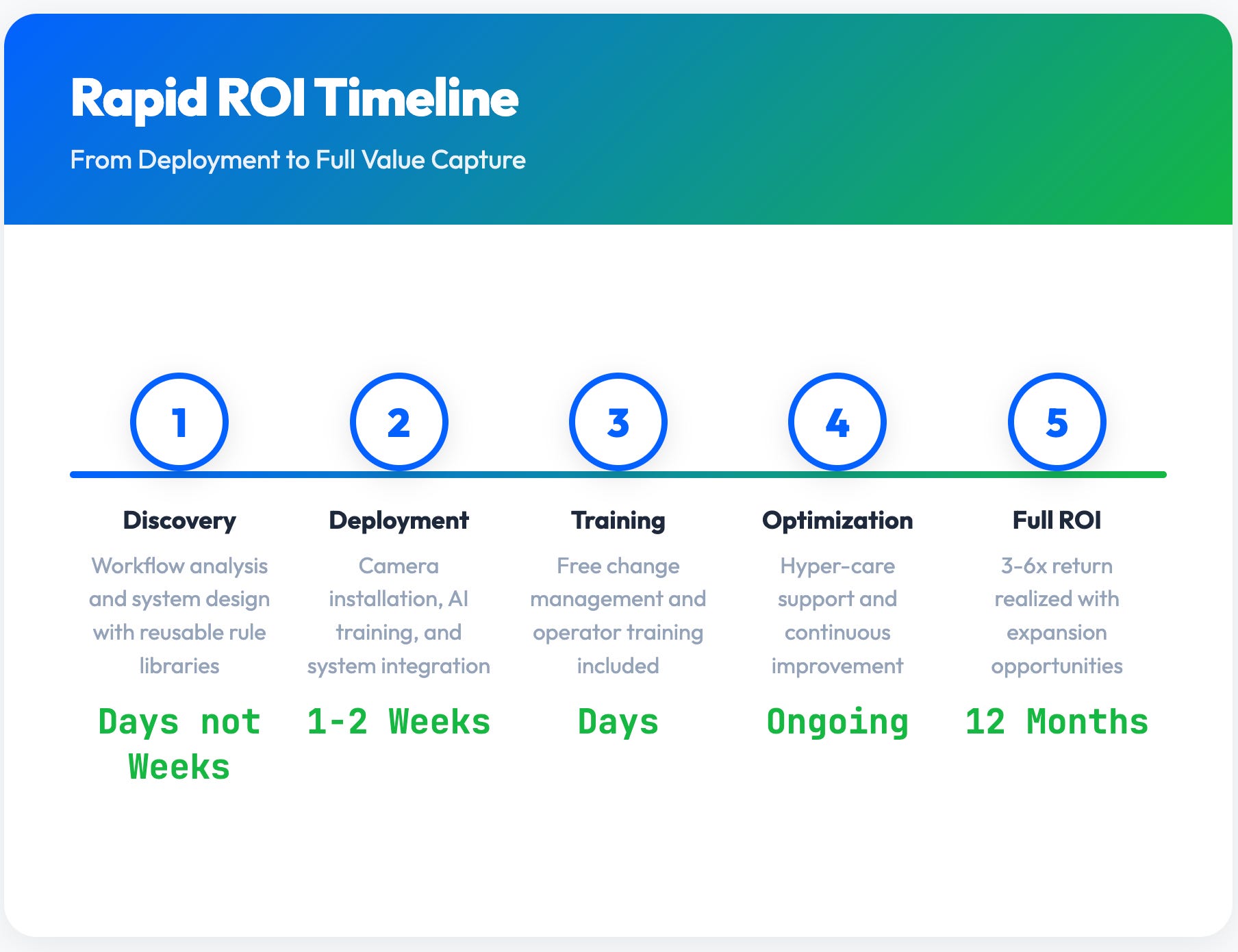
And so we start with that as our DNA. And so I call it kind of the three V’s at each category, the gate, the yard, and the dock. Are we providing velocity, visibility, which is efficiency, and then value at each of those areas? And can we ROI each of those? Because they can be modularized in enterprise. They may have made some investments, but they want to start. So that has to ROI. It has to cost benefit. So we lead with cost benefit to value. And we’re typically, because of the the benefit of all the hard work investment we made in AI, we’re seeing ROIs inside of 12 months and that’s three to six times our ROI because again, we’re able to come in lot less expensive, 10 times the capabilities, less time to deliver and really easy to use. So a great question. It’s our most important question.
Nikhil Varshney: Okay. And then one part of that question was like, what has been the most surprising element that you thought that would not provide this value, but has created a surprise value element for you?
Darin Brannan: Yeah, so we went in with yard operations in mind, and then we were quickly asked for fraud detection. Can your cameras do face recognition? Can they do bad actives? Can they start to correlate all the information and determine double brokerage bookings? Can you get to the massive fraud that’s building up? And our answer was, let us go experiment and figure it out. And now we’re coming back with that full module suite, which our customers and prospects are excited to see and deploy. And the other was, oh, we also have not only security, but perimeter security.
And then there’s a safety element that happens. People get hurt in the yard. Can you do predictive alerting? Can you do perimeter security all on that camera in addition to yard operations? And it turns out we can do that as well. That was a great surprise. So they’re more delighted. And then last is, as trucks come in, leave, and user owned it, can you do high correlation, high accuracy on data on the The truck damage detection.
Nikhil Varshney: Truck damage detection.
Darin Brannan: Yeah, so there’s damage that happens in the yard and there’s different types of customers that that matters more. OK. Where they might have rental areas and maintenance and so on. And we now have run that through our models and built models around that so we can do damage detection. That again, that’s what kind of ballooned our TAM. We knew that those were adjacencies, now they’re real. on the yard, and then now you have like multiple alternative. Yeah, so security and damage detection, those are massive market problems that nobody has been able to solve. And I think we’ve got the secret sauce to do.
Nikhil Varshney: Awesome. And I think kind of moving from this value more towards yard management to yard operations. And I know Terminal has a larger suite of solutions and the time is not just associated with trucking yards. There are ports, there are train yards. How do you see the overall correlation and how big that problem becomes when you add multiple other segments of the industry to this?
Darin Brannan: Yeah, that’s a great call out. We looked at ports and rails because our technology can address all yards. There’s a million and a half yards in the US, about 55 that are applicable in the 25,000 in the inland. We hadn’t focused heavily on the ports, on the rails, but we do view that as our next step opportunity because they made massive investments in tech. They have their own terminal operating system and they did some initial 1.0 computer vision. so now that we’ve been out in the market for a while, we’re now being pulled into those conversations and solving for some point solutions.
And then we’ll build out more of that yard operation tailored for their environment, which is different than in line yards to a degree. So that’ll be a separate segment because a separate adjacency segment or super excited and then international. Yeah, because we have, again, the best computer vision that we can train quickly. We think we have an advantage to. It will satisfy multinational companies that have international operations.
Nikhil Varshney: Makes sense. Moving from here, I would like to talk a little bit more about Terminal as a company. How big is the company now? How many customers, if you want to share that, how many customers do you have? And what are some of the greater learnings that you had with Terminal, which you didn’t have with other startups?
Darin Brannan: Great question. I don’t typically provide vitals about the company because competitors, but I appreciate the question. But I will say that I think we’re the largest and we have the best in class team for what we’re doing. I haven’t seen any competitor that comes close to having this kind of dominant product with the best in class team. Of course, I’m wildly biased on those two things. And then in terms of. I forgot the last question.
Nikhil Varshney: The learning that you had, which you didn’t have.
Darin Brannan: Yeah, there’s it’s it. There are a lot of universal truths to building a business. I break it into four stages. And so as soon as I got together with this team, I figure out what stage we’re at. And there’s a list of must do things. And then there’s a list of. Idiotic things not to do how you stay is how I call it. And so I think if if you use that playbook, you have a better probability of getting to each stage towards market leadership.
So all that to say. I try to take out the chaos and provide some predictability and performance and the way we would go about the market. But there’s always surprises. There’s always market hold, stretch, some ideas around pivot. And so far, the only surprise, I guess, is how quickly. I knew the market was going to start to go into discovery for YARC, but I’m finding that they’re moving quickly. I think they’re doing more pilots with AI native companies and they’re finding lower cost, greater benefit. And so we’re starting to see that spike where the industry wants to kick the tires with us.
They want to see, you know, what do we have and is this my long-term two to five year solution? So I don’t have to rip and replace or deal with, you know, point solutions. That that’s happening faster than I thought in this kind of heavy industry. So that’s a pleasant surprise.
Nikhil Varshney: I mean, no negative surprises yet. Just taking from that point, right? I mean, I look at I have been through two eras only. So internet era and the AI era, if I can call them. The internet era basically gave us unlimited distribution and the tax or the cost was writing software. in AI, distribution was already there with internet. Writing code is almost free if you can do good wipe coding. What becomes the most challenging part in your opinion? Because if someone can write wipe code, a terminal like application, let’s say, what sets up our terminal in modes that no one else can copy?
Darin Brannan: Excellent framing. Excellent question again. You know, I look at it on a couple of fronts. You’re right. AI, even since I’ve been building this business, it’s becoming less expensive to code. And our engineers are all over over that. And that’s why we’re coming in as AI natives, you know, half the industry cost or less. So we’re riding that wave well. You know, I think if you focus on mid to enterprise customers, they have a lot of legacy and inertia and they’re okay to set course for a 10 year modernization.
And so the way in which you design your business, enterprise, modern tech stack, the data layers are correct, agentic, the security, the scalability, the intercalable modularity and configurability. that’s not easy to vibe code straight out of the box. Like that in itself, that modernized enterprise tech stack is a moat.
The other is I brought together operators and technologists. So the fusion of domain experts and technologists make sure that we’re speaking a language, we’re on the yard with them, we’re building the workflows that are tightly integrated to the way in which they’re going to modernize and scale. That’s a relationship business. That’s a DNA verticalization business. that’s hard for any Vibe coders to pop up and say, look, we have an AI. And that all comes with having worked with enterprises for years. they demand high quality, they demand intergable, modular, configurable, and they demand a cost benefit in ROI. And so the technology is kind of a means to get to all that. if you can, like computer vision, I know that’s a moat. That was millions of dollars to get right. There is no hacking through that today. And the rest is is the way in which you sell, service, deliver and support is its own IP.
Yeah. And then we’ve got hardware, services and AI. That’s kind of the future of sustainable startups in my opinion, is you can bring those together. That gives you moats.
Nikhil Varshney: Yeah. And I think that’s a very valid point. And I know I’m going to make a generic statement not specific to supply chain over here. Over the last couple of weeks, there have been a lot of noise about SaaS being dead. And I think my mind always goes to the direction that, you know, maybe the cost of building the software has gone down or probably will become zero over a period of time. But what you just said, like, you know, services, infrastructure, horizontal and vertical integrations that big tech companies and enterprises have provided, that is just hard to replicate. Building software is just one part of the job, which is a smaller part of the job, because it’s a process you want to automate. But then how you want to use that automated process across multiple other applications is where the real differentiation lies. And that’s where like big companies have survived for so long.
Darin Brannan: Yeah. And that’s well said, but even those big enterprise folks, they’re in for a dogfight for companies like us that get all of that, but then have way better tech transformation platform. They’re going to have a really tough time competing with that platform unless they throw out their tech and start over. Then we’ve got a headset. That’s my bias opinion.
The other piece that I almost forgot to mention, which is also part of IP. The way in which you deliver matters a lot. And part of that delivery is you can’t rely on their change management. Otherwise you’re stuck for 10 years. So we built a change management DNA and team. So we have our business model is we’re selling you this and we’re selling you change management. Guess what? Change management is free. We include it. We’re going to train you. going to send it. We will transition you. We do all that where we bring the donuts and pizza for your team to get them excited. And then we do hyper care after that to make sure that they have now transitioned into eliminating workflows and making their day easier and that they see like this is the good value prop and it make their life much easier.
Nikhil Varshney: Makes sense. And I think that was one part that I actually forgot to ask you about change management because you’re working with employees that sometimes could be hard to adopt new technologies and that’s where if the adoption is low, irrespective of how great the technology is, you won’t get the real benefits coming out of it. So what you’re saying is Terminal has boots on the ground, working hand in hand with those operators to help them understand how to use the technology in the best possible fashion.
Darin Brannan: Absolutely. And just to amplify that point, part of the massive adoption problem in tech is that many of these YMSs their first or second site, but they couldn’t get beyond that because they couldn’t get the adoption because they couldn’t get past the 50 year process as in trans processes because they didn’t hyper focus on change management as well as the tech was old and it was just observability tech versus moving and orchestration tech, is it has to provide 10 to 20 % increase on velocity throughput and efficiency. We’re in the throughput efficiency game. If it doesn’t do that, plus if we don’t manage the change management, And make it super easy to operate use and low, low lift on tech. You’re just not going to get an option and that’s what’s happened. So we’re trying to solve for all those prior adoption challenges.
Nikhil Varshney: This is one of the last questions that I’ll ask you. Thank you so much. But one question that I would end with is. At what point when you segment your customers. Do you realize that. below this threshold, it’s very difficult to convince the customer to buy a product because they’re too focused on building their brand or if they’re a shipper, they are too focused on kind of increasing their revenue and sales and we should not focus on that. So do you have a threshold above which you try to approach the customers?
Darin Brannan: Yeah, so initially as a startup, early stage, you refine your ideal customer profile so that you’re not doing too much customer work and slows down your initial momentum. So initially we had an ICP filter where below 20 moves a day in a yard, below 250,000 square feet in a warehouse. But we’ve since matured our tech to where we have low cost solution with or without cameras.
And part of that was by design, it was an easy lift once we built everything. But then we had our big three PLC. What are we going to do with all these really many yards that we have? They’re all on paper. I’d love to just, is there a low cost digitization way? We have a very low cost, very easy to deploy way to digitize those small yards. So now we have the full spectrum. I couldn’t be more happy about it.
Nikhil Varshney: So now we can come in with like no ICP restrictions. And that is fantastic because now you are also capturing the low hanging fruits, which are the cause of big disruptions as the industry and the organizations evolve. So I think congratulations on that. And thank you for having and sharing these thoughts with me.
Darin Brannan: Thank you. Really appreciate it. Great work.


